U.S. EV Market Shifts: Impacts on Investors and Semiconductor Demand
 Editorial Staff
The Facts -
- U.S. EV market slowdown shifts investor focus to diverse automotive tech.
- Increased hybrid sales offset plug-in declines, impacting semiconductor demand.
- China and Europe lead global EV market, emphasizing geographic strategy.
The Shifting Landscape of the U.S. Electric Vehicle Market
As the electric vehicle (EV) landscape evolves in the United States, investors and automotive suppliers are faced with new challenges and opportunities. While the demand for battery-electric vehicles (BEVs) and plug-in hybrid electric vehicles (PHEVs) is slowing, the rise of conventional hybrids is altering where growth in the automotive supply chain is expected. This shift impacts semiconductor revenue, manufacturing efficiency, and charging infrastructure investments.
Recent analysis on automotive chip shortages and silicon carbide has highlighted the risks of building capacity based on ambitious electrification projections. With the U.S. plug-in market slowing, it is crucial for investors to discern which companies can thrive amid changing consumer preferences. The key is to identify those that can grow alongside the vehicles consumers are actually purchasing.
U.S. Vehicle Sales Trends
In August 2026, sales of battery-electric vehicles in the U.S. dropped approximately 45% compared to the previous year, and plug-in hybrid sales fell by about 43%. In contrast, conventional hybrid sales saw a rise of approximately 16%. This shift resulted in an overall decline of only 14% in electrified vehicle sales, including fuel-cell vehicles, as the growth in conventional hybrids compensated for the fall in plug-in sales. Investors need to understand that an increase in electrified vehicle sales does not necessarily equate to higher demand for external charging.
Global Plug-In Demand
It's important to differentiate the U.S. market from the global EV market. In August, Greater China accounted for 57.8% of global BEV and PHEV sales, Europe for 21.4%, and the U.S. for just 5.5%. Combined, Greater China and Europe represented 79.2% of the global plug-in market. This data, derived from Table 1, excludes conventional hybrids and fuel-cell vehicles.
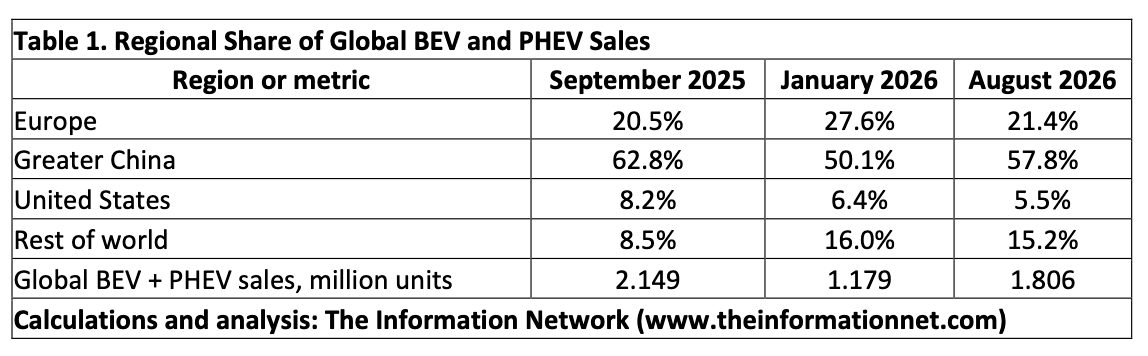
The vehicle volumes are presented in millions and rounded to three decimal places, and the percentages express the share of global plug-in vehicle sales. Note that this is not a penetration rate within each region, and rounding may prevent shares from adding up to 100%.
Investment Considerations in the EV Market
Investors should be cautious about interpreting the September-to-August changes as reflecting a seasonally adjusted trend. The figures from September 2025 were influenced by purchases made ahead of the expiration of the U.S. federal tax credit, while January figures represent different seasonal data. The distribution from August highlights a key point: a supplier's ability to tap into international demand is far more significant than a focus solely on the U.S. EV market might suggest.
However, gaining geographic access does not guarantee profitability. Sales in China, for instance, may subject suppliers to local competition, pricing pressures from customers, and initiatives to replace imported components. Key questions for investors include how much revenue a company generates from growing regions, whether it is increasing its presence in customer vehicles, and whether its business model supports healthy margins. Global EV expansion is not a universal solution for suppliers facing challenges with products, customer bases, or manufacturing costs.
---
Read More USA Works News